Shalyapin Bar
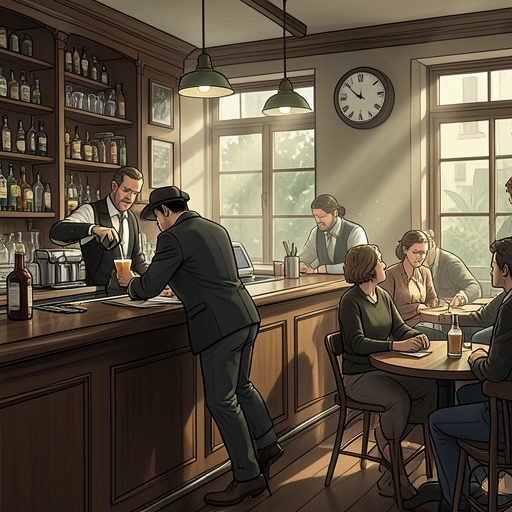
A Gentleman in MoscowShalyapin Bar is the Metropol’s lobby-side bar and one of the recurring social spaces through which the Count’s private reflections meet the hotel’s public life. Named in honor of a great Russian opera singer who had frequented the spot before the Revolution, it changes from a bustling watering hole into a quieter place of prayer and reflection. Its mahogany bar, banquettes, and wall of bottles give that quieter life a distinct setting: a familiar room where an empty glass can lead to a private reckoning, a reunion, or an unexpected interruption.
Setting and Atmosphere
The bar lies just off the lobby and is furnished in an American style, with banquettes around a mahogany bar and a wall of bottles. The Count’s affectionate name for it invokes the opera singer associated with its pre-Revolutionary past. The contrast between that earlier bustle and its later, chapel-like quiet gives the room an atmosphere suited to both sociability and solitude. A guest might find the Count alone with a brandy snifter, or encounter a small group gathered around the bar; neither state feels exceptional to the room.
The bar’s quiet is not emptiness. It affords the Count a place to observe the hotel’s passing lives while remaining within reach of its staff and regulars. On one evening, alone with brandy after an encounter that leaves him self-reproachful, he reflects on how readily a human undertaking can be made to sound noble in French. The thought belongs to his solitary mood, but the bar’s attentive service soon brings another person into the scene: Audrius, the tender at bar, offers to help with the Count’s jacket. The exchange makes the room’s hospitality personal and habitual, not merely a matter of drinks.
Hospitality and Repeated Rituals
Audrius’s service gives the bar much of its everyday character. He knows the rhythm of tending a customer: he approaches soon after someone takes a stool to ask what they would like, and returns when a glass is empty. His ready attentiveness is visible again years later, when the Count empties a glass intending to leave and Audrius arrives with the bottle to offer a house pour. By then the Count, past sixty, generally avoids alcohol after eleven because late drinks tend to wake him in the early hours. He nevertheless accepts this one, partly because refusing after Audrius has uncorked the bottle would be discourteous. The scene makes courtesy, like the aperitif, part of the bar’s nightly routine.
The Count also uses Shalyapin Bar as a regular point of return. After having his hair trimmed and his chin shaved, he chooses a corner table there while waiting for Mikhail Fyodorovich Mindich, in town for the inaugural congress of the Russian Association of Proletarian Writers. The bar’s ordinary social traffic provides a backdrop to the reunion: the Count notices a woman seated opposite him, then turns away just as Mindich arrives. Later, after sending Mindich to a discussion about the future of meter, the Count is headed to dine alone when Audrius beckons him and slides across a folded note whose sender is not yet identified. The bar thus serves not only as a place to linger but also as a quiet channel through which news and encounters reach him.
Encounters and Social Crosscurrents
The bar brings together people whose different purposes become visible in small scenes. During one nightly aperitif, the Count finds three young ballerinas standing in a row at the bar, their fingers resting on its surface as if preparing to plié. He recognizes them as newcomers to Moscow, recruited from the provinces to join the corps de ballet. Their youth and unaccompanied visit suggest inexperience in a hotel that is near the Bolshoi Theatre and also a favored place for the director to meet his prima ballerina. The Count joins them in conversation and begins a card trick, asking the most innocent-looking of the three to choose a card. Before the trick can proceed, he notices Arkady behind his shoulder, unusually unsettled and seeking a moment with him. The playful scene gives way to hotel business without requiring the bar to cease being a place of informal sociability.
Other encounters place friendship and desire in view. When Arkady reports that a visitor is wearing out the carpet behind the potted palms, the Count looks out from the bar and sees Mindich pacing across the lobby. The movement recalls Mindich’s restless habits, familiar since the two men were twenty-two; after they embrace, they climb five flights to the attic. On another occasion, the Count watches a willowy woman at a banquette and turns his attention away just as Mindich arrives. The bar is therefore a vantage point for the Count’s observations, but it also exposes him to the sting of feeling envy at his friend’s romantic prospects.
The room can host disagreements as readily as reunions. While finishing a brandy one evening, the Count overhears a high-spirited young Brit praising Russian church architecture and the rambunctious tenor of the language. A German traveler responds dourly that Russia’s only contribution to the West is vodka. The Count’s attention is drawn first to the Brit’s enthusiasm, then to the exchange itself. In the bar’s mixed company, judgments about Russia are not delivered in a formal forum; they surface over drinks, where visitors’ contrasting views can share the same stretch of counter.
A Place for Celebration and Plans
Shalyapin Bar accumulates its own customs through repeated visits. In 1946, the Count and Richard Vanderwhile first become acquainted over a magenta concoction made by Audrius. Richard challenges the bartender to invent cocktails in the colors of St. Basil’s Cathedral, producing the Goldenrod, the Robin’s Egg, the Brick Wall, and a dark green Christmas Tree. The bar develops a playful test of endurance as well: anyone who drinks all four in succession may claim the title of Patriarch of All Russia, at least until consciousness returns. Four years later, when Richard, now attached to the State Department, visits Moscow, the two friends still meet at the Metropol for a nightcap. They raise Goldenrods to old friends, their easy companionship grounded in shared education, upbringing, and appreciation of the same cultural world.
The bar also frames a later moment when the Count is preparing to act. After discovering a date in the Boyarsky reservation book that could serve his plan, he arrives at six o’clock to find the regulars celebrating the first business success of Pudgy Webster, an American trying to sell vending machines in Russia. The Count accepts champagne from Audrius with a smile of his own: he has cause to celebrate, though the people around him do not know what it is. A gust of frozen air and an urgent whisper interrupt the moment almost as soon as he raises his glass. On another late night, after reviewing his escape checklist over brandy, he intends to go upstairs; Audrius’s offer of a house pour keeps him seated, where the Count turns his attention to a laughing group of Americans.
Across these scenes, Shalyapin Bar is more than a backdrop for drinks. Its service rituals sustain the Count’s routines, while its changing company repeatedly draws him into friendship, observation, embarrassment, and planning. The room’s historical name and altered quiet hold the past beside the present; its doors remain open to private thought, but its bar keeps producing encounters.